



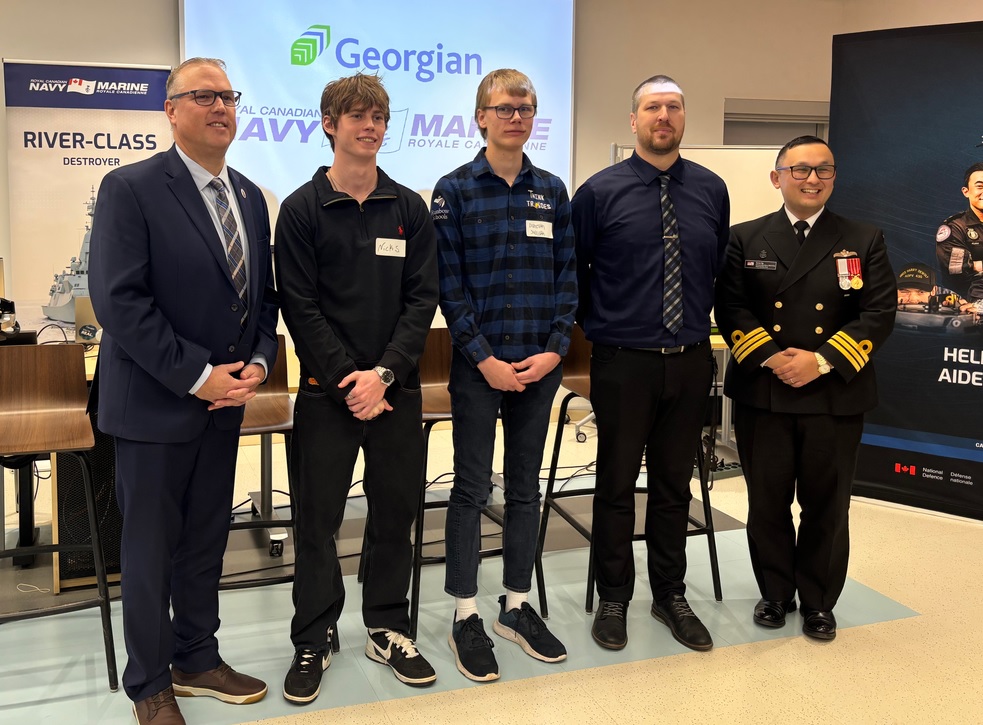
Georgian College’s Owen Sound campus was able to celebrate its collaboration with the Royal Canadian Navy.
The partnership revolves around Georgian’s Marine Studies program, which has two goals: to entice students to enrol in the program, and to prime them to serve with the Navy.
The program is called the Non-Commissioned Member Subsidized Training and Education Program (NCMSTEP).
Commander Kevin Ng, Chief of Staff for the Naval Reserves (Central Region) of the Royal Canadian Navy was at the event and shared how positive the program is both for the school and for the military.
“Ships at sea have always been in need of folks with the technical expertise to move, float, and fight,” said Ng. “I would say that recognizing the scale of growth that the Navy expects to have over the coming years, the expansion of the fleet that we have, and the people that we require to sustain that fleet, there’s been this focus on the people aspect of focusing on bringing more people into the Navy. Here at Georgian College, there’s a tremendous amount of expertise with respect to Marine Technology, with respect to Navigation, and the entire marine sector, and it was a natural partnership to be able to leverage that expertise here at Georgian and bring that to the Navy.”
Since the partnership was announced in August, the school currently has six students who are in the Marine Studies program’s two pathways — Marine Engineering Technology and Marine Technology-Navigation.
Benefits of students signing up for NCMSTEP typically means that tuition is covered, and the students can also earn a full-time salary while attending their classes, provided the student meets the requirement to complete basic training.
During a panel discussion, it was also shared that students who are already enrolled in one of Georgian’s Marine Study program may also have the option of signing an agreement with the Navy that could give them an employment opportunity.
For first-year student Nick Steeves, the agreement combines his love of engineering, a desire to travel the world, and his family’s influence to join the Navy.
“My brother had a lot of good things to say about the Navy already,” said Steeves, whose brother is currently posted in Halifax. “It’s nice to travel, and I’ve always had a thing for engines.”
Steeves said that the coursework involved in the Marine Engineering program is completely applicable to real-world knowledge, and emphasizes both theoretical and practical training.
He shared that the faculty make learning seem easy.
“They’re great,” said Steeves. “I’ve loved it here. The faculty are really supportive. I find all of the teachers are great at their teaching, [and] they’ve had more than enough experience in the industry.”
His classmate, Dunovan Sullivan, said that the program presents a good challenge while pursuing career goals “It’s a lot of hard work that you have to do in this program. You have to push through it, and it will be worth it.”
For students like Steeves and Sullivan, the NCMSTEP allows students like them to be able to learn job skills and be able to complete their post-secondary education without having to shoulder student loan debt.
“It allows us to bring in Naval students that will be compensated by the Navy to be students in our Marine Engineering program, it eliminates one of the financial barriers… and it provides guaranteed employment upon graduation,” said Kent Simpson, the Director for the Centre for Marine Training and Research, and the Associate Dean for Marine Studies and Power Engineering. “It’s a win-win for the students, and it’s great for the College to keep our enrolment numbers up and keep the programs viable.”
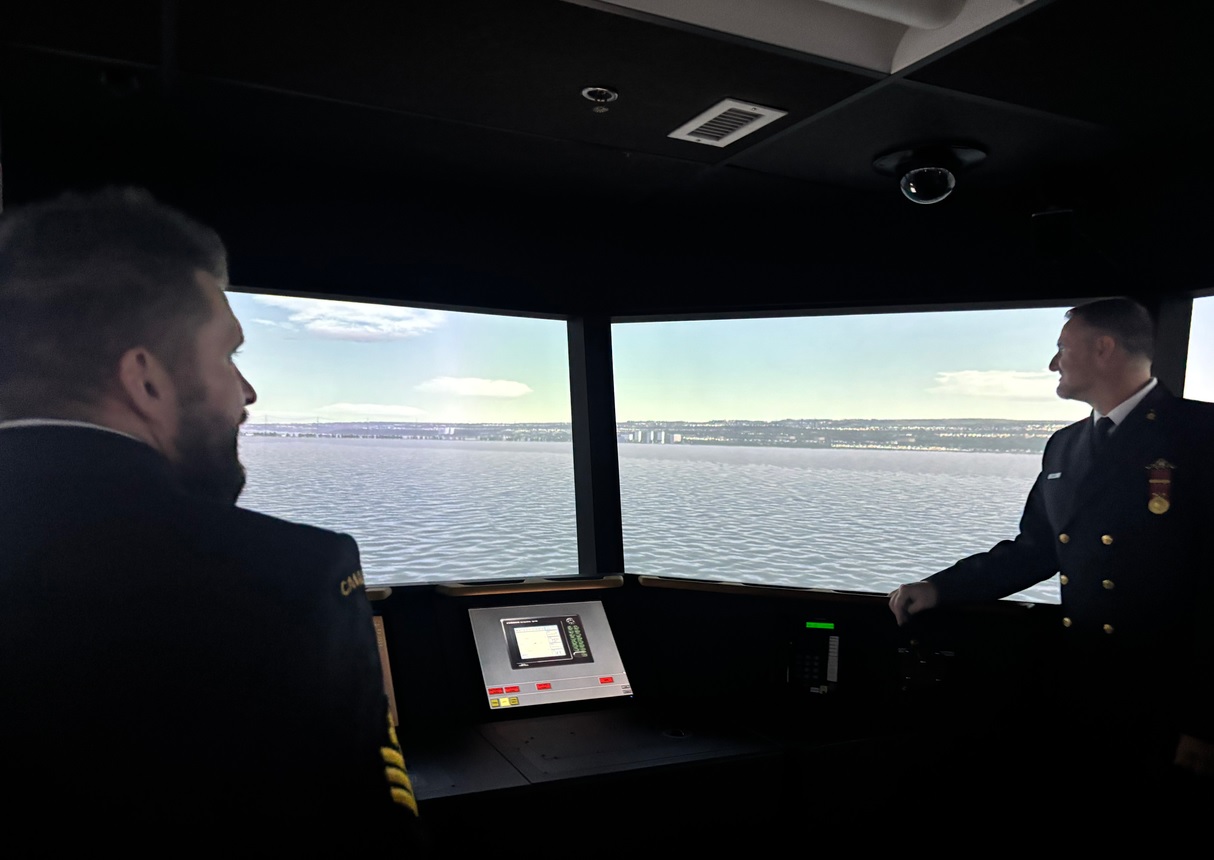
Two officers of the Royal Canadian Navy take in a ship bridge simulator at Georgian College’s Owen Sound campus on November 23, 2026 (photo by Jill Charlebois/Bayshore News)

Comments